


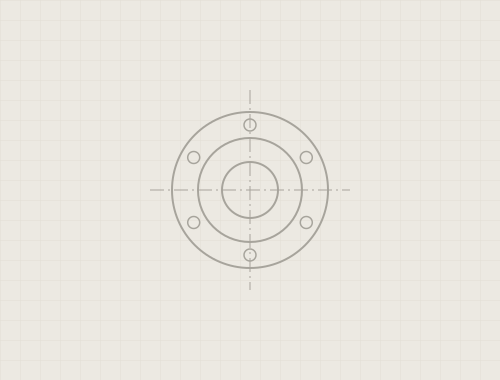


Section A–A · ISPL 2401 conical spring seal
Anatomy of a mechanical seal
One seal, cut open and taken apart. Step through the five views, or play them from the start.
- Dwg
- IS-2401-XS
- Scale
- NTS
- Sheet
- 1 / 1
- Rev
- [placeholder]
01 / 05 · Section
Cut along the shaft
The ISPL 2401 conical spring seal, fitted on a pump shaft and sliced down the middle.
-
Hatched means cut.
The top half is sliced down the middle so you see inside each part.The top half is sliced down the middle.
Dash-dot is your pump.
The stuffing box belongs to the pump. The seal fits inside it.The seal fits inside its stuffing box.
Shaded is outside.
The bottom half shows each part from outside, as you would see it fitted.The bottom half shows each part fitted.
-
Seal faces
One turns with the shaft, one is held still. They run against each other.
Springs
Pushes the turning face onto the still one, and keeps it there as they wear.
Secondary seals
O-rings seal the head to the shaft and the seat to the gland plate.
Gland plate
Bolts to the stuffing box and carries the still seat. A pin stops it turning.
Drive collar
Locks to the shaft and turns the spring with it.
-
- Fitted 1st
Drive collar
Locked to the shaft. Turns the spring.
- Fitted 2nd
Spring
Conical. Pushes the head towards the seat.
- Fitted 3rd
Rotating head
Carries the turning face and the shaft O-ring.
- Fitted 4th
Stationary seat
Sits in the gland plate on its own O-ring.
- Fitted 5th
Gland plate
Bolts to the stuffing box over the gasket.
- Fitted 1st
-
- Face pair
- [placeholder]
- Face flatness
- [placeholder]
- Spring load, fitted
- [placeholder]
-
Between the faces
Closed by the seal faces
Along the shaft, under the head
Closed by the head O-ring
Behind the stationary seat
Closed by the seat O-ring
Between gland plate and pump
Closed by the gasket
Part by part
What each part does
Every mechanical seal does the same five jobs. Here is each part on its own, in orange.
Part 1 of 5
Seal faces
Two flat rings do the sealing. One turns with the shaft, the other is held still in the gland plate. They run against each other, and the thin band where they touch keeps the product in.
- Rotating face
- Turns with the shaft, carried by the rotating head
- Stationary seat
- Held still in the gland plate, located by a pin
- Face materials
- [placeholder]
Part 2 of 5
Springs
The conical spring pushes the rotating face onto the stationary seat, and keeps it there as the faces wear.
- Type
- One conical spring
- Driven by
- The drive collar, so it turns with the shaft
- Spring material
- [placeholder]
Part 3 of 5
Secondary seals
O-rings close the gaps the faces cannot reach. One seals the rotating head to the shaft. One seals the stationary seat to the gland plate.
- Head O-ring
- Closes leak path 2, along the shaft
- Seat O-ring
- Closes leak path 3, behind the seat
- Elastomer
- [placeholder]
Part 4 of 5
Gland plate
It bolts to the stuffing box of the pump and carries the stationary seat. A pin stops the seat turning. A gasket seals the plate to the pump.
- Carries
- The stationary seat and its O-ring
- Seals to the pump with
- A gasket, closing leak path 4
- Material
- [placeholder]
Part 5 of 5
Drive collar
It locks to the shaft and turns the spring and the rotating head with it.
- Fixed to the shaft by
- [placeholder]
- Turns
- The spring and the rotating head
- Material
- [placeholder]
Your pump
Which seal is in your pump?
The drawing shows the ISPL 2401. Your pump may need a different seal. Tell us the pump and the product, or send a photo of the old seal.